AEROSUB has reached an important milestone with the definition of six demonstration scenarios that will guide the validation of the project’s autonomous robotic technologies in representative offshore wind environments.
Developed in close collaboration with end-users, including offshore wind operators such as Ocean Winds and EDP, these scenarios ensure that AEROSUB’s technological developments address real operational challenges faced by the industry. By aligning technology development with end-user needs and expectations, the project is creating a clear pathway from research and innovation to practical offshore applications.
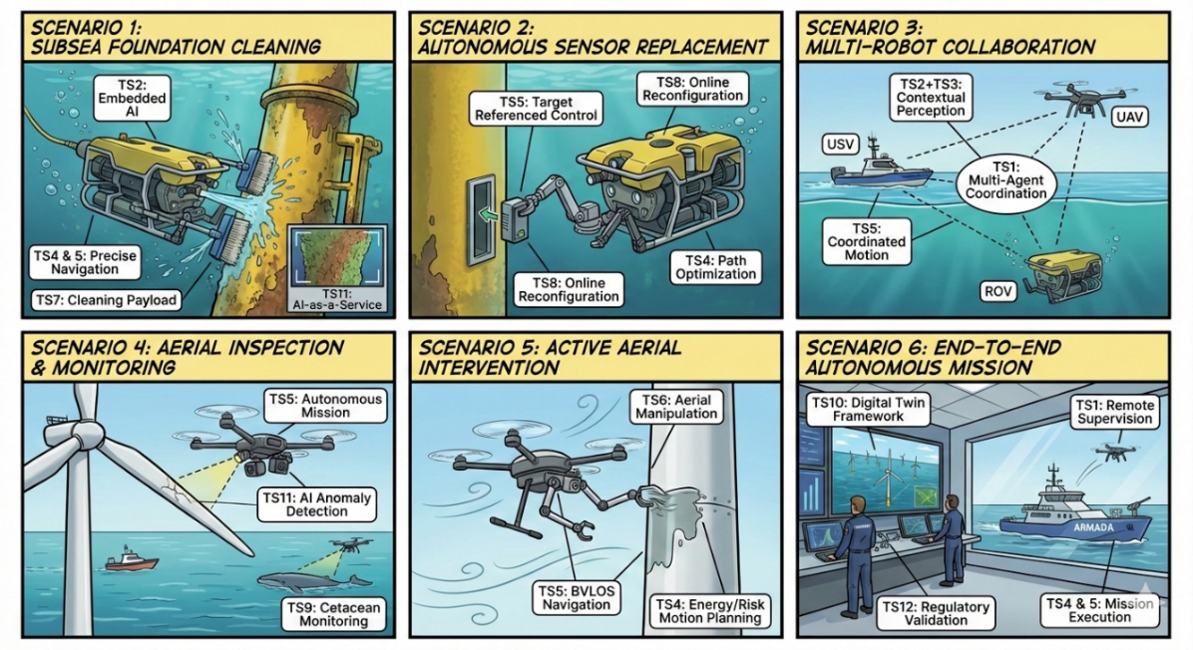
The six demonstration scenarios will serve as the testing ground for AEROSUB’s 12 technological solutions, bringing together aerial, surface and underwater robotic platforms, artificial intelligence and digital twin technologies into increasingly complex operational environments.
Addressing critical offshore maintenance challenges
The first scenarios focus on subsea inspection and maintenance activities that are traditionally difficult, costly and often require human intervention in challenging offshore environments.
One scenario will demonstrate the autonomous cleaning and close-range inspection of offshore foundations, tackling issues such as biofouling and corrosion that can compromise the integrity and lifetime of offshore structures.
Another scenario will validate the autonomous deployment and retrieval of underwater sensors, showcasing the ability of robotic systems to perform highly precise manipulation tasks typically carried out by human divers.
Enabling multi-robot collaboration
Moving beyond individual robotic systems, AEROSUB will also demonstrate coordinated operations involving unmanned surface vehicles (USVs), remotely operated vehicles (ROVs) and unmanned aerial vehicles (UAVs).
Through a dedicated multi-domain inspection scenario, multiple robotic agents will work together to inspect offshore structures above and below the waterline, supported by intelligent mission planning and real-time situational awareness.
This scenario represents an important step towards integrated robotic ecosystems capable of carrying out complex inspection missions autonomously.
From inspection to intervention
In addition to inspection activities, AEROSUB is also exploring how autonomous systems can actively contribute to maintenance operations.
One demonstration scenario will focus on aerial inspection of turbine structures, including damage assessment and marine life monitoring, while another will validate aerial contact operations for coating maintenance and surface preparation.
These activities represent a significant shift from autonomous data collection towards robotic intervention, expanding the role of robotics in offshore wind operations and maintenance.
Towards end-to-end autonomous offshore inspection
The final demonstration scenario will bring together all major AEROSUB technologies in a fully integrated mission managed from an onshore control centre.
By combining aerial, surface and underwater robotic assets with AI-powered decision support and an Operational Digital Twin, the project aims to demonstrate how offshore inspections can be planned, executed and supervised through a unified autonomous workflow.
This integrated scenario represents AEROSUB’s vision for the future of offshore wind operations: safer, smarter and more efficient inspection and maintenance activities supported by coordinated robotic systems.
Looking ahead
As the project progresses, the demonstration scenarios will play a central role in validating AEROSUB’s technologies under realistic conditions and assessing their potential to support the future of offshore wind operations.
By translating industry needs into concrete operational use cases, these scenarios provide a clear framework for demonstrating how robotics, artificial intelligence and digital twin technologies can contribute to the next generation of offshore inspection, maintenance and repair solutions.