AEROSUB partners presented two scientific papers at the 9th Iberian Robotics Conference (ROBOT 2026), held from 18 to 20 November in Barcelona, Spain, highlighting research on UAV simulation and resilient communications for aerial robot teams.
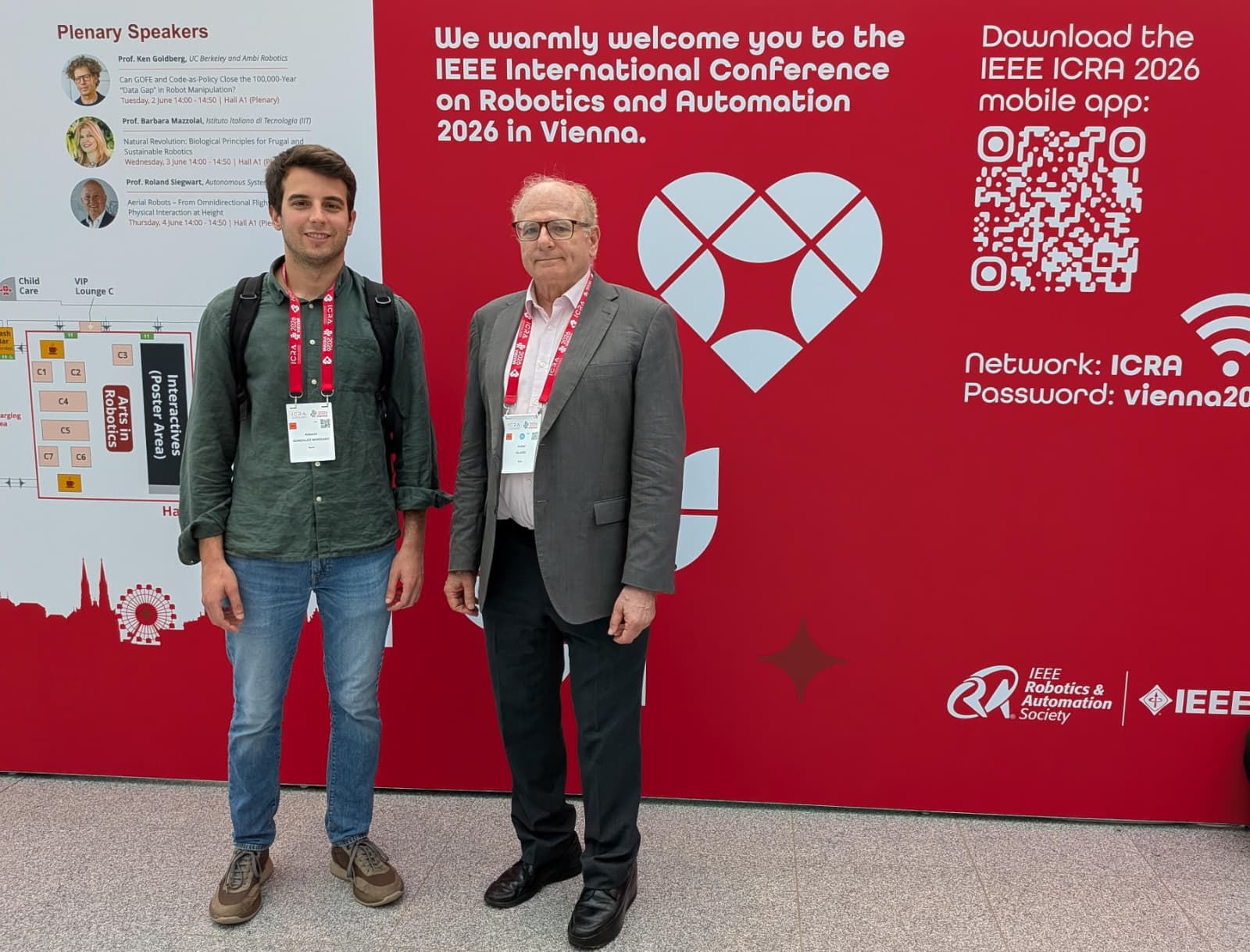
Researchers from INESC TEC and the University of Seville represented AEROSUB at ROBOT 2026, an international forum bringing together researchers and professionals to discuss advances across robotics, autonomous systems, artificial intelligence, navigation and simulation.
The conference took place at the Universitat Politècnica de Catalunya (UPC) and the Spanish National Research Council (CSIC), with both AEROSUB-related papers presented during the opening day of the event.
Building resilient communications for aerial robot teams
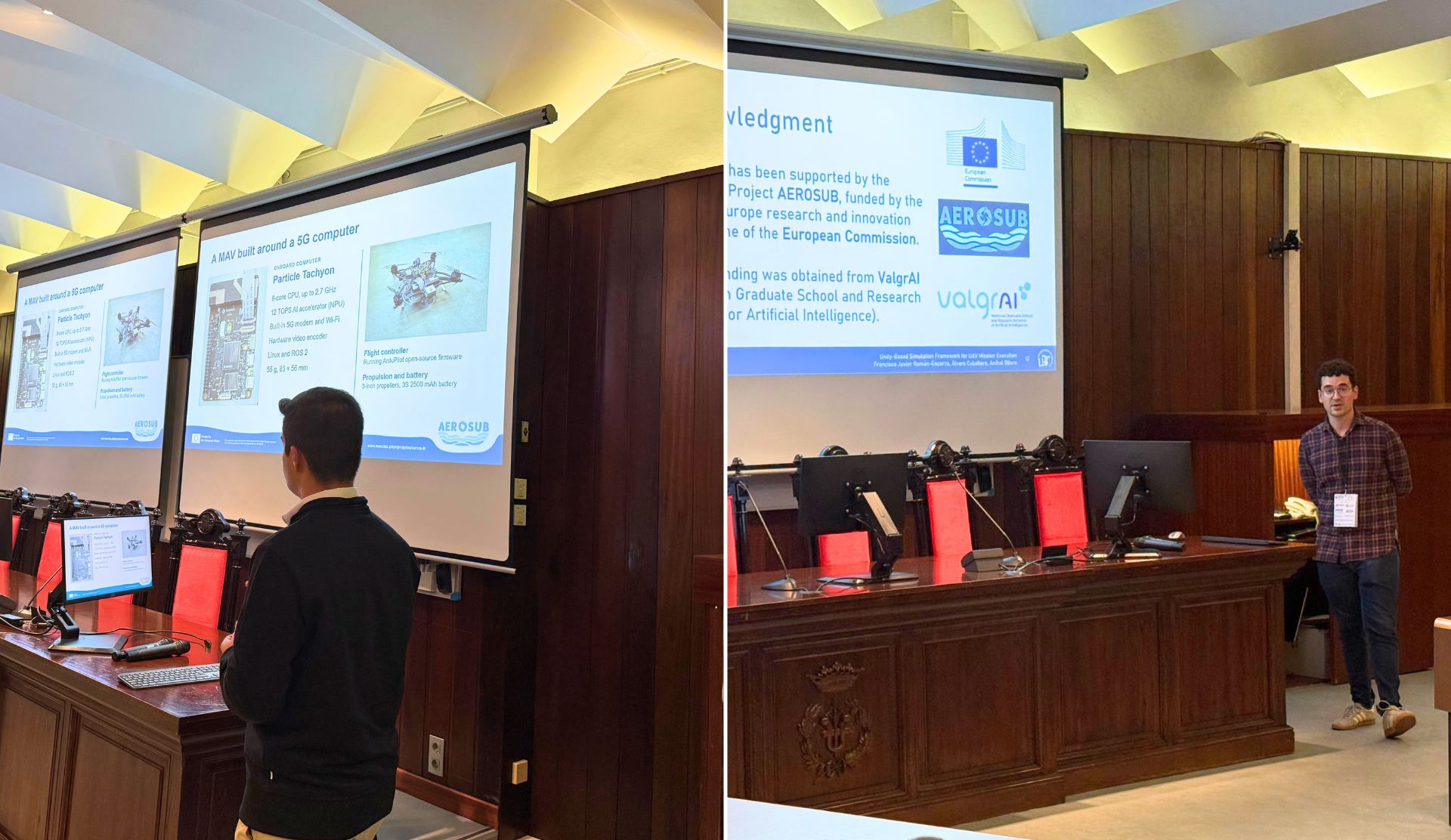
Leandro Resende, researcher at INESC TEC, presented “Micro Aerial Vehicle Platform for Resilient Swarm Communications”, co-authored with Diogo Moutinho, Alexandre Vilhena Costa, Daniel F. Campos and Andry Maykol Pinto.
Presented during the Swarm Robotics session, the work explores a lightweight Micro Aerial Vehicle (MAV) platform designed to support communication between multiple aerial robots and a Ground Control Station through a 5G mobile network. The platform combines a compact aerial vehicle weighing less than 400 grams with onboard computing and a ROS 2-based software architecture. This enables cellular connectivity, video streaming and information exchange between vehicles, creating a foundation for future decentralised swarm coordination. Initial experiments demonstrated low communication latency between the different components of the system, supporting its potential use in missions requiring remote operation, real-time video and communication between multiple aerial robots.
Testing UAV missions safely before real-world deployment
A second paper, “Unity-Based Simulation Framework for UAV Mission Execution”, was presented by Álvaro Caballero Gómez from the GRVC Robotics Lab at the University of Seville and co-authored with Francisco Javier Roman-Escorza and Aníbal Ollero.
The research introduces a Unity-based simulation framework designed to test UAV missions under realistic conditions before they are carried out in the real world. The framework reproduces elements including UAV dynamics, sensors, wind conditions and autonomous landing capabilities, while allowing one or several aerial vehicles to be simulated simultaneously. By testing mission behaviour virtually, researchers can identify potential problems and refine operations before deploying physical robots, reducing the risks associated with real-world trials.
The paper was also selected as a finalist for the ROBOT 2026 Best Paper Award, recognising the relevance of the research presented at the conference.
From research to autonomous offshore operations
Both contributions address technological challenges that are relevant to AEROSUB’s broader ambition to advance autonomous robotic operations for offshore wind inspection and maintenance.
Reliable communication between robotic platforms is essential for coordinating multi-robot operations, while realistic simulation environments allow complex missions to be tested and refined before deployment. Together, these research activities contribute to the development of safer and more robust autonomous systems capable of operating in challenging environments.